4E35D261D4C8D801FCFDD5C1D04ED94E Fix Broken Relationship

Monday, July 28, 2025

How to Apologize in a Relationship and Actually Be Heard

 🙏 How to Apologize in a Relationship and Actually Be Heard

Man and woman sitting face to face, one holding the other's hands with sincere expression.


When it comes to how to apologize in a relationship, most people get it wrong by trying to win instead of heal — but there’s an art to being heard, forgiven, and respected all at once.


📝 Quick Summary:

How to apologize in a relationship isn’t about groveling or throwing “I’m sorry” around like confetti — it’s about taking ownership, offering empathy, and showing change. This post breaks down apology anatomy that actually works (and doesn’t trigger a defensive meltdown).


💡 Intro Paragraph:

How to apologize in a relationship the right way can transform conflict into connection. A powerful apology doesn’t just say “I’m sorry” — it communicates, “I see how I hurt you, and I’m committed to doing better.” Real apologies are less about perfection and more about responsibility.

Here’s how to stop making it worse — and start making it right.


✅ 6 Elements of a Powerful Apology That Builds Trust

✔️ Start by naming what you did — no sidestepping.
Bad: “I’m sorry if you were hurt.”
Better: “I’m sorry I snapped at you in front of your friends. That wasn’t fair.”

✔️ Validate the impact, not just your intent.
Say: “I can see how that embarrassed you and made you feel unsupported.”

✔️ Resist the urge to defend or explain.
The minute you say “But I was just—” you’re protecting your ego, not the relationship.

✔️ Use “I” statements to show ownership.
Say: “I lost my temper. I need to work on that.”

✔️ Offer change, not just remorse.
“I’m working on this in therapy,” or “Next time I’ll walk away and cool off before we talk.”

✔️ Ask what they need to move forward.
Give them the floor: “Is there anything I can do to help rebuild trust right now?”


❓FAQ Section

Q: What’s the difference between saying sorry and actually apologizing?
A: “Sorry” is a word. An apology is a process that involves reflection, accountability, empathy, and often behavioral change.

Q: What if my partner doesn’t accept my apology?
A: That’s their right — especially if the wound is fresh. Stay consistent, be patient, and let your actions speak over time.

Q: Should I still apologize if I didn’t mean to hurt them?
A: Yes. Intent doesn’t erase impact. You can apologize for how something made them feel, even if it wasn’t intentional.

Q: Can apologizing too often backfire?
A: Absolutely. Apologizing for things you didn’t do or over-apologizing makes your words lose weight. Stick to real accountability.


🔗 You Might Also Like:


📘 Recommended Book:

📕 Nonviolent Communication: A Language of Life by Marshall Rosenberg – This is the gold standard on empathetic expression and powerful apology.

👉 View on Amazon Click Here!


🔐 Affiliate Disclaimer

Some links may be affiliate links. If you choose to purchase through them, I may earn a small commission at no extra cost to you. Thanks for supporting the mission of helping hearts heal.


🧠 Saying Sorry the Right Way Builds Deeper Love

The goal of a good apology isn’t to “win” the argument — it’s to win back trust.
And when done well, it doesn’t just fix what’s broken... it often brings you closer than before.


How to Apologize in a Relationship and Actually Be Heard


Monday, July 21, 2025

When to Walk Away from a Relationship—And How to Do It Without Regret

 🏃‍♂️ When to Walk Away from a Relationship—And How to Do It Without Regret

Man leaving a room with a duffel bag, while a woman sits on a couch looking down, lost in thought.  🖼️ Image Title Text:

Knowing when to walk away from a relationship can be one of the most painful — but also most powerful — decisions you ever make. It’s not weakness. It’s wisdom.


📝 Quick Summary:

When to walk away from a relationship is a question that sneaks in during those quiet, lonely moments of doubt. If you're feeling more drained than fulfilled, it may be time to assess what’s keeping you in... and what’s holding you back.


💡 Intro Paragraph:

When to walk away from a relationship is a decision that takes courage, clarity, and a deep dose of self-respect. Too many people stay out of fear: fear of loneliness, change, or starting over. But sometimes, staying is what’s actually breaking you.

If you're torn between fixing and walking — this guide is for you.


✅ 7 Signs It’s Time to Walk Away — And How to Do It With Dignity

✔️ You’ve lost yourself in the process.
If your goals, values, or identity are disappearing just to keep the peace — it’s not love. It’s emotional erosion.

✔️ You’ve tried… and they haven’t.
You’ve done the therapy, initiated the talks, read the books — and they’re still passive or defensive. One-sided effort is exhausting and unfair.

✔️ There’s emotional, verbal, or physical abuse.
No explanation or backstory justifies abuse. If fear is driving your daily decisions, it’s time to go.

✔️ You’re constantly walking on eggshells.
Love should feel safe, not like a battlefield. If every conversation is a trap, peace won't come from staying.

✔️ You’ve outgrown the relationship.
It’s possible to still love someone and know they’re not growing with you. That gap will only get wider.

✔️ You imagine life without them and feel relief.
Not excitement. Not joy. Just… peace. That’s your nervous system telling you something.

✔️ You've stopped trusting them—and yourself.
If the relationship constantly makes you question your worth, reality, or sanity... it's time to trust your instincts instead.


❓FAQ Section

Q: What if I still love them? Should I still leave?
A: Love isn’t always enough. If the relationship is harming you or keeping you stuck, walking away can still be the most loving act — for both of you.

Q: How do I walk away without guilt?
A: Guilt comes from believing you’ve failed. But if you’ve tried and the relationship still hurts more than it heals, choosing peace isn’t failure — it’s strength.

Q: Should I stay for the kids?
A: Kids learn love from what they see, not what you say. Staying in an unhealthy home teaches them that dysfunction is normal.

Q: What if I regret it later?
A: Regret is normal — but it’s rarely permanent. What stays with you longer is the pain of staying too long in something that drained your soul.


🔗 More Posts That Can Help You:


📘 Reader Favorite Resource:

📕 Attached: The New Science of Adult Attachment – Understand why you keep attracting (or staying with) the wrong people, and how to build secure relationships.

👉 Check it out on Amazon 


🔐 Affiliate Disclaimer

Some links may be affiliate links. If you click and purchase, I may earn a commission at no additional cost. Your trust matters, and I only promote what I believe in.


🧠 Letting Go Isn’t Giving Up — It’s Choosing Growth

You don’t owe anyone a version of yourself that’s dying inside.
You owe yourself freedom, healing, and the space to breathe again.

If you’re reading this with a heavy heart, know this: you are not alone — and you will rise again.


When to Walk Away from a Relationship—And How to Do It Without Regret

Monday, July 14, 2025

How to Get Your Ex Back (Without Looking Desperate or Losing Yourself)

 💘 How to Get Your Ex Back (Without Looking Desperate or Losing Yourself)

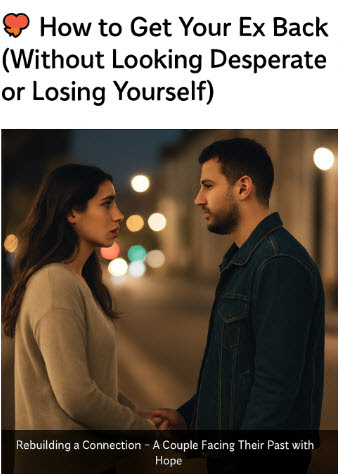
Rebuilding a Connection – A Couple Facing Their Past with Hope


Trying to get your ex back can either be an empowering journey or a self-destructive spiral — depending on how you approach it. Desperation repels, confidence attracts.


📝 Quick Summary:

Trying to get your ex back is tricky business. If you beg, you lose power. If you disappear completely, you risk being forgotten. This post shows how to balance space, confidence, and reconnection — without sacrificing your dignity.


💡 Intro Paragraph:

How to get your ex back begins with a hard truth: you must become someone they miss, not someone they pity. That doesn’t mean playing games. It means focusing on growth, self-awareness, and authentic connection.

If you're thinking about a comeback — make it your glow-up first.


✅ 7 Steps to Win Back Your Ex Without Losing Your Mind

✔️ Pause the panic.
Right after the breakup, your emotions are loud, raw, and irrational. Don't act from that place. Give both of you time to miss each other without the chaos.

✔️ Don’t chase — attract.
No long, teary texts. No "just checking in" DMs. Instead, work on you. Post a photo of you living life. Reclaim your energy.

✔️ Reflect on what actually broke the relationship.
Was it timing? Insecurity? Neglect? Don’t gloss over it. If you don’t heal it, even if you get back together — it’ll just break again.

✔️ Send a power message.
After 30+ days of silence, send something neutral but sincere. Example:
"Hey, just wanted to say I’ve been doing some growing and thinking. No pressure — just wanted you to know I appreciate what we shared."

✔️ Rebuild attraction slowly — like a new relationship.
Flirt again. Laugh again. Remind them why they fell for you — not why they left you.

✔️ Stay outcome-detached.
You’re not doing this to “win.” You’re doing this to see if you both can work as evolved versions of yourselves.

✔️ Make sure you’re not trying to get them back just to avoid pain.
You’re not lonely — you’re temporarily healing. Don’t confuse the two.


❓FAQ Section

Q: How long should I wait before contacting them?
A: At least 30 days of no contact is standard — but it depends on how the relationship ended. Use that time for healing and clarity, not stalking their feed.

Q: What if they’ve already moved on?
A: Then it’s your job to move forward too. You deserve someone who’s emotionally available and fully present — not just physically next to you.

Q: Should I ask for closure?
A: Sometimes closure is self-given. But a calm, mature convo can help if both of you are open. Don’t beg for it. Request it with confidence.

Q: Can getting back together actually work?
A: Absolutely — if both people grow. But if you’re just running from loneliness or replaying the past, it rarely lasts.


🔗 You’ll Also Love:


📘 Recommended Resource:

📕 The Ex Factor Guide – Learn how to reconnect emotionally, not just romantically, using psychology-backed steps.

👉 View on Amazon (Replace with actual affiliate link if needed)


🔐 Affiliate Disclaimer

This post may contain affiliate links. I may earn a small commission if you buy something — at no extra cost to you. I only recommend what I believe in.


🧠 If It’s Real, It’ll Return — Stronger, Wiser, and More Ready

Begging never brings them back.
Becoming the best version of yourself might.

If the love was real and the timing is right, they'll find their way back — not to the old version of you… but to the one who rose after the fall.


How to Get Your Ex Back (Without Looking Desperate or Losing Yourself)

Wednesday, July 2, 2025

What Counts as Cheating in a Relationship


🧠 What Counts as Cheating in a Relationship? (And What Most People Get Wrong)

The Blurred Lines of Betrayal – When Does Cheating Actually Begin?


Cheating in a relationship isn’t just sex — it’s secrecy. And today, those lines are more blurred than ever. From flirty DMs to emotional affairs, this post explores the modern definitions of betrayal and what really crosses the line.


📝 Quick Summary:

Cheating in a relationship includes more than just physical contact. Whether it’s an emotional connection, secret communication, or digital infidelity, betrayal is about crossing agreed-upon boundaries — even if they were never spoken out loud.


💡 Intro Paragraph:

Cheating in a relationship isn’t as simple as “sleeping with someone else.”
Today, it might be Snapchat messages, Instagram likes at 2 a.m., or deep conversations shared with someone who isn’t your partner.
So where is the line — and who decides?


✅ What Counts as Cheating (And What You Need to Talk About)

✔️ Physical Cheating
Classic case: kissing, touching, sex. But even a “one-time” hookup often signals deeper issues.

✔️ Emotional Cheating
This is when your heart goes where your body hasn’t. Sharing secrets, confiding emotionally, fantasizing — without your partner knowing.

✔️ Digital or Online Cheating
Flirty messages, secret DMs, OnlyFans subscriptions, or having a secret profile. If it’s hidden — it’s suspect.

✔️ Micro-cheating
Subtle boundary-pushing. Things like hiding a friendship, downplaying a connection, or texting someone you once had feelings for.

✔️ Financial Infidelity
Yup, this counts too. Secret accounts, undisclosed gifts, or spending to impress someone else = broken trust.

✔️ Intentional Secrecy
If you wouldn’t do it in front of your partner… why are you doing it?


❓FAQ Section

Q: Is flirting cheating?
A: Depends on the relationship. If it’s secretive or feels emotionally charged — many partners consider it a betrayal.

Q: Can emotional cheating hurt more than physical?
A: Often yes. Emotional bonds cut deeper and last longer than a one-night stand.

Q: What if we never defined boundaries?
A: Time to start now. A strong relationship has clear agreements, not assumptions.

Q: Is watching adult content considered cheating?
A: Only if it violates an agreement or becomes a hidden, compulsive behavior.


🔗 Related Relationship Truth Bombs:


📘 Want to Go Deeper?

🎧 The State of Affairs by Esther Perel – One of the best books ever written about infidelity, why it happens, and what’s underneath it all.

👉 Get it on Amazon


🔐 Affiliate Disclaimer

Some links may provide a small commission. I only recommend tools that I trust and believe in.


🧠 Cheating Isn’t Just What You Do — It’s What You Hide

If you’re hiding it, denying it, or defending it before being asked — it’s worth questioning.
In today’s world, honesty isn't just about the truth. It's about transparency.

What Counts as Cheating in a Relationship

Tuesday, July 1, 2025

5 Relationship Killers and How to Avoid Them

 5 Relationship Killers and How to Avoid Them

Couple reconnecting emotionally in a peaceful outdoor setting


5 Relationship Killers and How to Avoid Them - Discover the top 5 relationship killers that silently destroy intimacy and how to avoid them. Learn how to build emotional safety and lasting love, and unlock a man’s deepest desire using His Secret Obsession.

Don’t let hidden fears or toxic patterns sabotage your love life. In this post, we reveal five of the most destructive relationship killers and how to overcome them. Learn how to cultivate real emotional connection, boost trust, and reignite attraction—plus, discover the one obsession every man craves.


5 Relationship Killers and How to Avoid Them

After 37 years counseling couples, I’ve seen one truth repeat again and again:

Most relationships don’t fail because of a lack of love—they fail because of fear.

Fear of rejection, fear of being controlled, fear of inadequacy—these fears drive behaviors that erode trust, intimacy, and passion.

If you're struggling to hold on to love or wondering why you keep attracting the wrong partner, it may be time to look inward. Here are the five relationship killers that silently sabotage love—and how to heal them.


1. Controlling Behavior

Controlling behavior is often rooted in a deep fear of rejection. It manifests in two ways:

  • Overt Control: Blaming, yelling, criticizing, threatening, judging.

  • Covert Control: Passive-aggression, withdrawing, lying, denying, over-explaining.

The more one partner tries to control, the more the other resists—creating an exhausting emotional tug-of-war.

This dance doesn’t breed safety; it breeds distance. If you want to rebuild connection, try shifting from control to curiosity.

✉️ Related Post: Why He Pulls Away From You — And How to Reignite His Passion


2. Resistance

Some people enter relationships with a hidden fear of engulfment—being controlled or losing themselves.

They resist emotionally by:

  • Withdrawing

  • Procrastinating

  • Becoming emotionally "numb"

  • Shutting down communication

When one person controls and the other resists, the relationship gets stuck in a cycle of stagnation, resentment, and loneliness.

To break the cycle, both partners must develop emotional boundaries and learn how to express needs without blame.


3. Neediness

If you enter a relationship hoping your partner will:

  • Make you feel worthy

  • Heal your emptiness

  • Erase your loneliness

…you’re setting yourself up for disappointment.

Neediness is a symptom of self-abandonment. When you don’t take responsibility for your own emotions, you seek emotional rescue from others—which quickly leads to co-dependency and burnout.

Pro Tip:

Discover how to tap into just one feature of male psychology that can make you his obsession. Click here to unlock His Secret Obsession


4. Substance & Process Addictions

Addictions are often a mask for emotional pain. Whether it’s alcohol, food, gambling, workaholism, shopping, porn, or even excessive social media use—these behaviors disconnect you from your partner and your true self.

Healing begins when you stop trying to numb or avoid emotional pain and begin to take radical personal responsibility. Inner Bonding or journaling are great starting points.


5. Eyes on the Wrong Plate

You know what your partner does wrong.

  • He’s withdrawn.

  • He’s moody.

  • He’s emotionally unavailable.

But how often do you reflect on your part?

  • Do you nag?

  • Do you silently seethe?

  • Do you hold resentment like a security blanket?

As long as you're focused on fixing him, you avoid looking at you. And that stops growth.

Self-awareness and vulnerability are the keys to growth. When you lead by example, transformation follows.


The Fastest Way to Reignite His Obsession

Healing Emotional Distance in Relationships

You don’t need to chase love, over give, or guess what he wants.

Relationship expert James Bauer reveals that men have one biological "secret obsession" that’s even more powerful than sex, love, or money—and when triggered, it turns a man into a loyal, committed partner.

🔗 Click here to discover His Secret Obsession

Use these simple emotional triggers to:

  • Make him see you in a new light

  • Build unstoppable romantic tension

  • Create a connection that other women can’t compete with

Learn the secret obsession that every man craves more than love, money, or sex. Start Here →


Final Thoughts: Healing Starts With You

The truth is, relationships fail when we lose sight of our own healing.

To truly thrive in love, you must:

  • Take full responsibility for your emotional health

  • Heal your fears of rejection or loss

  • Shift from blame to self-awareness

  • Learn to communicate with clarity, not control

A great relationship doesn’t just happen. It’s built.

And the foundation begins with you.


Internal Links:

External Resource:


Affiliate Disclaimer: This post contains affiliate links. That means we may earn a small commission if you make a purchase using our link—at no additional cost to you. We only promote products we truly believe will support your relationship growth.


Image Prompt 1 (Feature Image):

A romantic couple sitting close on a park bench during golden hour, holding hands gently, expressing emotional intimacy and vulnerability. Warm colors, soft lighting, cinematic style.

Alt Text: Couple reconnecting emotionally in a peaceful outdoor setting Alt Title: Healing Emotional Distance in Relationships

Image Prompt 2:

A split-screen image showing a couple arguing on one side and later embracing on the other side, symbolizing relationship conflict and healing. Style: realistic, relationship-focused, emotional storytelling.

Alt Text: Conflict and healing in a romantic relationship Alt Title: Avoiding Relationship Killers and Rebuilding Intimacy

Image Prompt 3:

A confident woman smiling, journaling or practicing self-care, symbolizing emotional responsibility and inner work. Style: modern, inspiring, warm tones.

Alt Text: Woman doing personal growth work Alt Title: Healing Yourself to Heal Your Relationship


5 Relationship Killers and How to Avoid Them

How to Stop Enabling Addictive Behavior in Your Partner

 How to Stop Enabling Addictive Behavior in Your Partner

📝 Quick Summary: Enabling isn’t the same as helping. Learn the difference and set boundaries that support real recovery.

💡 Enabling behavior often comes from a place of love, but it can keep your partner stuck in destructive patterns. The real help starts when you say “enough.”

✅ Main Content Sections:

  • 🚫 What Enabling Looks Like

    • Making excuses for their addiction

    • Covering up consequences

    • Giving money or shelter to avoid reality

  • 🧭 Why We Enable

    • Fear of losing them

    • Guilt or past trauma

    • Confusing love with sacrifice

  • 🧱 How to Set Loving Boundaries

    • “I love you, but I won’t support this behavior.”

    • Refuse to fund or rescue harmful behavior

  • 🌱 Encourage Accountability & Recovery

    • Suggest therapy or support groups

    • Focus on your own healing too

❓ FAQ Section:

  1. What’s the difference between helping and enabling?

  2. How do I set boundaries without pushing them away?

  3. What if they relapse?

🔗 Includes Internal Links:

📘 Download CTA: Want to reconnect in a healthy, drama-free way? Learn His Secret Obsession

🔐 Affiliate Disclaimer: This post contains affiliate links. When you purchase through them, we may earn a small commission at no extra cost to you.


How to Stop Enabling Addictive Behavior in Your Partner

Why Communication Fails: The #1 Relationship Mistake

 ✅ Why Communication Fails: The #1 Relationship Mistake


📝 Quick Summary: Poor communication isn’t just about what’s said—but how it’s heard. Misunderstanding can quickly become emotional distance.

💡 Intro Paragraph: Relationship communication fails when couples focus on winning arguments instead of solving problems. The most powerful conversations begin with empathy.

✅ Main Content Sections:

  • 🧏 Listening to Understand, Not to Respond

    • Let your partner finish without interrupting

    • Reflect back what you heard

  • 😡 Watch Out for Toxic Patterns

    • Criticism, contempt, defensiveness, and stonewalling

    • These 4 horsemen (per Dr. John Gottman) destroy connection

  • 💬 Use “I” Statements Over “You” Blame

    • “I feel ignored when I talk and don’t get a response.”

    • Avoid “You never listen!”

  • 🎯 Schedule Tough Talks

    • Avoid high-stress times

    • Have intentional time set aside for important discussions

❓ FAQ Section:

  1. Why do we always end up fighting?

  2. Is poor communication a deal-breaker?

  3. Can couples learn to communicate better?

🔗 Includes Internal Links:

📘 Download CTA: Want to learn the most effective way to talk so he listens? Discover His Secret Obsession

🔐 Affiliate Disclaimer: This post may include affiliate links. That means we may earn a small commission at no extra cost to you.

Why Communication Fails: The #1 Relationship Mistake